Souls of SOLS, January 2026

Brandon Favre, Molecular and Cellular Biology PhD candidate


Risa Aria Schnebly
January 20, 2026

Note: This story is part of an ongoing series profiling graduate students in the School of Life Sciences. Read the last feature here.

Image
A man with facial hair and glasses smiles in a rainforest.
Brandon Favre

No one likes the flu, but Brandon Favre takes hating it to another level. 

“ASU Health Services did me dirty when I was an undergrad, and totally botched my flu vaccine. And I was like, I’m gonna make it so I don’t have to get flu vaccines anymore, and just try to cure the flu.”

The flu is a rapidly-mutating virus, which allows it to adapt to the vaccines that teams of scientists create each year, and persist beyond them. That’s why everyone’s supposed to get their flu shot each year: to prevent against the latest iteration of flu virus. But Favre hopes to create a vaccine that can outsmart the pesky virus.

“I’m making a vaccine against the flu called Final Boss,” he declared.

Though it might not count as “curing” the flu, Favre is working to create a vaccine that targets the regions of the flu virus that don’t mutate from one year to the next. 

“We basically took a target on the flu virus that normally the immune system just kind of ignores. Because it doesn’t change between seasons, we finally have a conserved target to go after.”

Favre has identified 13 areas of the flu virus that tend to stick around from season to season. His Final Boss vaccine targets all of those areas at once. Now, he’s just waiting to get funding so he can test the Final Boss out.

Another point of pride for Favre is that he’s created the Final Boss––as well as other vaccine platforms he’s helped develop––entirely using plants.

“Plants can make complex proteins, and they’re also dirt cheap. You just need some seed funding––but I’ll leave the plant puns alone.” 

On top of being cheap, it’s easy to produce a whole lot of plants at once. If scientists started using them more for vaccine products, Favre says, one day producing and distributing vaccines might also happen on a faster and larger scale. 

In his spare time, Favre has spent his entire PhD staying deeply involved in student government. He’s served in ASU’s Graduate Student Government for six of the last seven years, during which he helped create a grant to cover graduate students’ publication costs, and also has spent years serving on the SOLS E-board, helping create the mental health coordinator position. 

“I really care about the SOLS community,” he explains, “SOLS is probably the reason why ASU is number one in innovation. The coolest research happens here.” 

Favre has felt that way since he was an undergraduate at ASU. Like many others, he initially planned to go to medical school, but got pulled in by the cutting-edge research he saw. 

“SOLS was just like, ‘Yo, check this out: we make plants glow in the dark, we grow vaccines in plants, we have zebrafish that are regenerating their faces.’ And I was like ‘Oh, I wanna be a part of that.” 

So, Favre committed to doing a PhD, though he still wanted to do work with medical applications. 

“I still want to help people’s health, I want to solve big problems. But I feel like the only way to solve huge problems is to take moonshots at diseases like the flu, and see if it works out.” 


Souls of SOLS: Highlighting graduate student stories


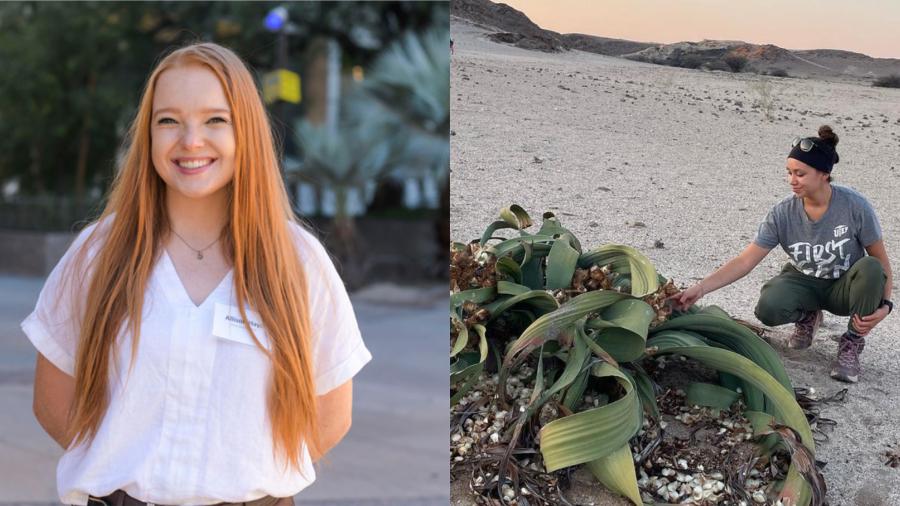
Allison Hays, left, and Isabel Torres, right.


Risa Aria Schnebly
April 29, 2024

Note: This story is part of an ongoing series profiling graduate students in the School of Life Sciences. See March’s featured students here.  

The research that goes on in the School of Life Sciences spans a huge and fascinating variety of subjects. The graduate students who make up SOLS are no less diverse or interesting, arriving at their respective research from different places and with different passions. Here, we recognize a handful of these graduate students, their work and what motivates them to pursue it. 

Allison Hays – Neuroscience 

Our childhood experiences have a huge impact on the rest of our lives; they shape our beliefs about the world, the relationships we form, and our physical and mental health well into adulthood. Allison Hays, a second-year neuroscience PhD student in the BEAR Lab, is diving deeper into understanding how our experiences are so impactful by exploring their interaction with genetics. 

Allison Hays

Hays specifically thinks about how childhood experiences affect certain cognitive functions, like the ability to remember things, pay attention, and switch easily from one task to another. But rather than looking at the brain to figure this out, she looks at our spit––the easiest way for her to get samples of DNA. When she looks at spit samples, she doesn’t just try to read the DNA they contain; she’s more interested in seeing how the DNA within them is being regulated. Specifically, she looks for occurrences of DNA methylation, which is a modification that prevents gene expression.  

“We don't have all of our DNA being expressed at one time. There are things that turn gene expression on and off, or up and down.. So, what we look at is not necessarily what genes you are given, but what genes are on, off, up, down, etcetera. So that's then going to affect... your biology, your health, and cognition. I specifically think about how stressful experiences can be associated with poorer health and different rates of development and aging- which may ultimately go on to impact a variety of things.” 

So, Hays measures the cognitive performance of her research subjects, assesses how stressful their early childhood experiences were and looks at what genes are turned on or off in the DNA in their spit samples. With all that information together, Hays can start to understand how early childhood stress can change gene expression and affect cognitive performance. 

This holistic look at stress, genetics and brain function altogether excited Hays, who conducted related research with the Arizona Twin Project and the Memory Attention Control lab at ASU as an undergraduate. Now, she’s conducting novel work that she hopes will one day improve how scientists assess and improve humans’ health and wellbeing.  

“I think it will be extremely important for assessing people's level of health risks depending on their childhood stress levels, and monitoring whether any types of treatments or interventions are working... By looking at the gene expression, we’ll finally be able to see on a genetic level which treatments are working and which are not.” 

Isabel Torres – Environmental Life Sciences 

Arizonans might think they’re well-acquainted with the desert, having lived among its summer monsoons, soaring temperatures, and temperamental dust storms. But most Arizonans have no idea why the desert is important. 

Not Isabel Torres. The second year PhD student in the Throop lab is dedicating her research to better understanding deserts and other dryland ecosystems, which most people have overlooked.  

“Deserts are amazing. People think that there's nothing living or going on there. But there's so much activity.” 

Isabel Torres

A third of the world’s human population already lives on drylands, or ecosystems like deserts defined by water scarcity, and that number will only increase: by the end of the century, drylands will likely make up 56% of Earth’s land cover, Torres explains. To protect the people who depend on drylands, scientists must understand how to best manage and care for that land. But that’s not something they currently understand. 

Torres plans to help correct that. She’s spending her PhD doing field work to study how carbon cycles through dryland ecosystems, which is important for scientists who make models that predict what the climate will look like in the future. Current climate models for dryland ecosystems rely on data collected from other ecosystem types, which is troubling –– it means that those models are inaccurate. Torres aims to generate data that can be used to make accurate climate models, which will help land managers take care of the land. 

That goal, Torres shares, is inspired by her hometown: “I grew up in El Paso, Texas. It’s a desert. But it wasn’t always a desert. Back in the 1800s, it was a grassland. It was pretty and beautiful. But then they overgrazed the landscape, leading to desertification... So, I’m really interested in land management practices and how we can take care of the land.” 

Torres recognizes that living on drylands is tough: water and other resources are scarce, so people must work to prevent desertification where they can. At the same time, she loves the desert, and though she knows life there is tough, she doesn’t want that to stop people from seeing how much the land still gives us. She hopes her work can help people protect the land in return.